
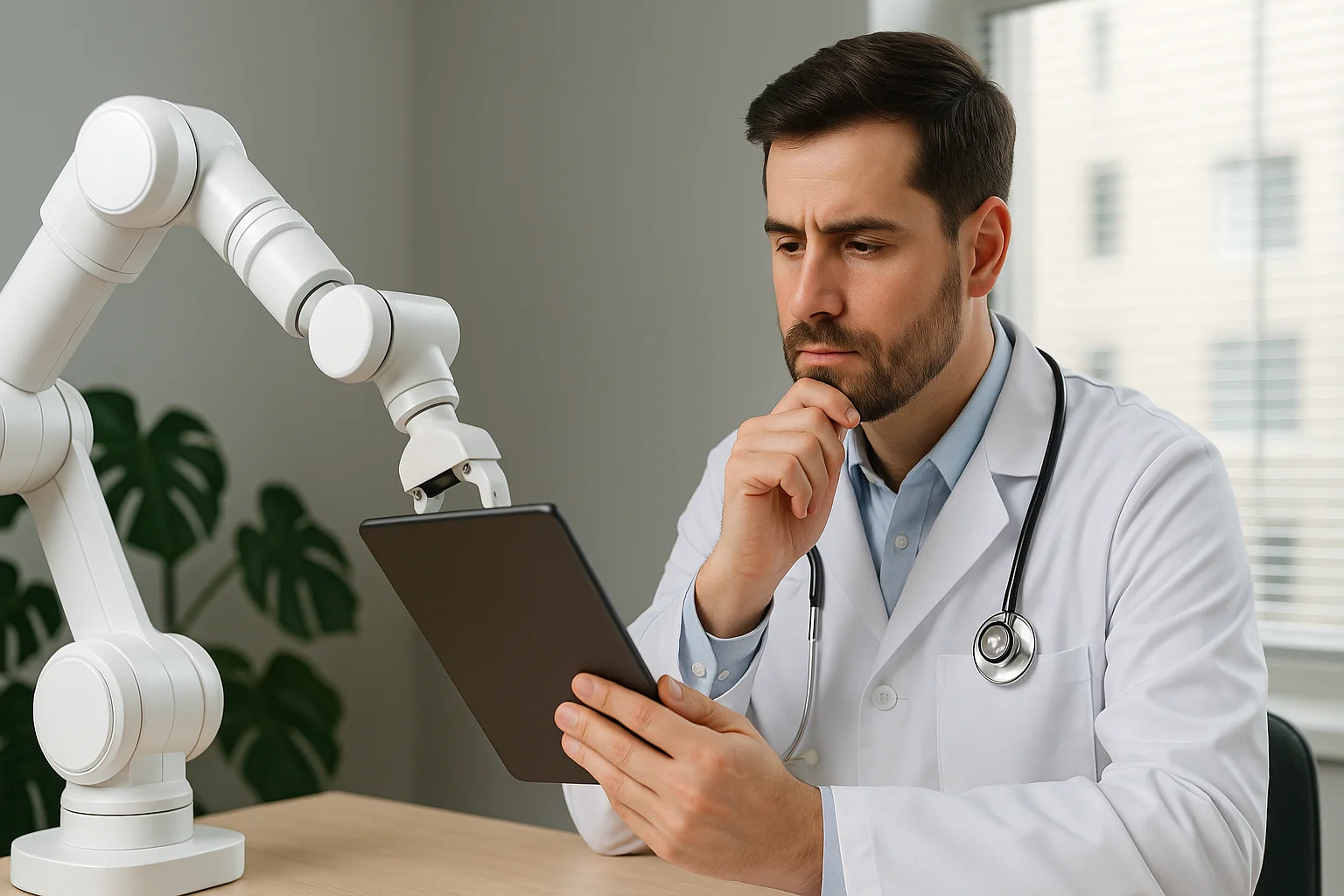
The Role of the Doctor in an Automated World
The role of the doctor in an automated world
In the previous article, “Medical blockchain: the era of absolute security and traceability”, we explored how technology is guaranteeing the trust and integrity of clinical data. But while machines secure information and algorithms process millions of data points in seconds, an inevitable question arises: what place does the doctor hold in this new automated world?
From executor to health strategist
For decades, medical work was loaded with administrative tasks, manual diagnoses and repetitive processes. Today, many of those functions are being automated by artificial intelligence systems, clinical software and integrated platforms. But far from displacing doctors, this revolution is giving them back their most human purpose: understanding, accompanying and deciding with sound judgment.
The doctor of the future will no longer be just the one who diagnoses, but the one who interprets data, leads interdisciplinary teams and makes strategic decisions based on the information technology provides. Knowledge remains their tool, but empathy becomes their superpower.
The irreplaceable value of the human touch
Automation can analyze thousands of medical images, but it cannot look a patient in the eye and understand their fear. It can predict a disease, but it cannot explain with tenderness what it means to receive a difficult diagnosis. That is why 21st-century medicine needs emotionally intelligent doctors more than ever, capable of translating data into human decisions.
The future of medicine is not a replacement but an alliance: doctor and machine working together, each complementing what the other does best. AI brings speed; the professional brings sensitivity.
From scalpel to algorithm: new medical skills
Technological progress is also changing medical training. Tomorrow's doctors will need to understand concepts of data science, bioethics, programming, artificial intelligence and predictive analytics. Not to become engineers, but to understand the tools that will accompany each of their clinical decisions.
The new doctor does not fear technology: they master it, question it and improve it. They will be a digital leader who knows when to trust an algorithm and when to trust their instinct.
Ethics in the age of automation
As algorithms play a larger role in decision-making, the doctor's ethical role grows stronger. They remain the guardian of humanity within the system. They must ensure that automated decisions are fair, explainable and empathetic. The doctor thus becomes the moral filter between technology and life.
Their task will not only be to treat diseases, but to ensure that technological progress remains at the service of the patient, and not the other way around.
The new medical leadership
The healthcare professional of the future will also be a change manager. They will lead hybrid teams where doctors, engineers, data analysts and psychologists work together to create innovative solutions. They will be a guide who unites disciplines and reminds everyone —machines included— why medicine exists: to care.
Conclusion
The role of the doctor in an automated world does not disappear; it grows. While systems process information, the doctor processes emotions. While machines execute, the doctor decides. Technology does not replace their essence: it enhances it. The doctor of the future will not be less necessary but more relevant, because in a world of cold data, their warmth will be the real differentiator.
← Previous: Medical blockchain: the era of absolute security and traceability
Related Articles
Keep exploring similar content.
The Future Is Hybrid: Human Medicine + Artificial Intelligence
The future of medicine is neither human nor artificial: it is hybrid. An alliance between the doctor's empathy and the precision of algorithms that promises to save more lives and provide better care.
Smart Hospitals: What Healthcare Will Look Like in 2030
By 2030, hospitals will not just be buildings: they will be digital ecosystems where artificial intelligence, robotics and data come together to deliver personalized, safe and more human care.
Ethics, Privacy and Consent in Digital Medicine
Ethics, privacy and consent are the three pillars of modern digital medicine: they ensure that technology protects patient data and respects human will in every digital decision.