
Smart Hospitals: What Healthcare Will Look Like in 2030
Smart hospitals: what healthcare will look like in 2030
In the previous article, “Ethics, privacy and consent in digital medicine”, we reflected on how trust and ethical responsibility are the foundation of all healthcare innovation. Today we take a step into the future to imagine how those principles, combined with artificial intelligence, automation and data analysis, are giving life to a new reality: smart hospitals.
From the traditional hospital to the connected ecosystem
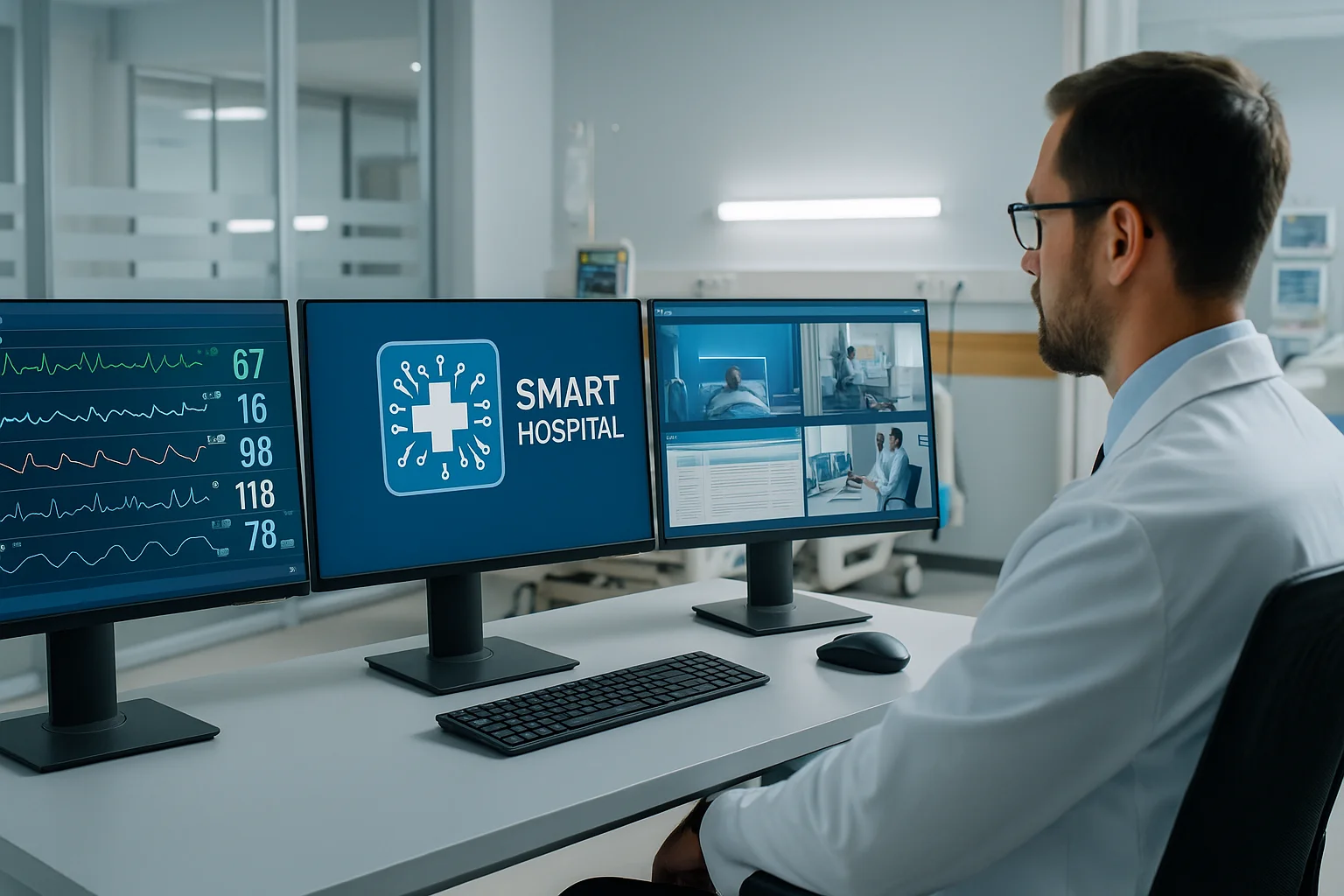
For decades, hospitals were synonymous with infrastructure: hallways, beds, monitors and medical staff. But by 2030, hospitals will evolve into something more complex and fascinating: interconnected digital ecosystems, where every device, patient and professional is part of a living network of information.
In these environments, data flows securely thanks to interoperability and medical blockchain, ensuring that every clinical decision is based on accurate, verified information. The result: more agile, personalized and person-centered care.
Artificial intelligence as a clinical assistant
In 2030, algorithms will be as common as stethoscopes. Artificial intelligence (AI) will analyze medical records in seconds, suggest differential diagnoses and recommend personalized treatments based on the patient's genetics and habits. But the doctor will remain at the heart of the process: the human interpreter of technological precision.
AI will make it possible to reduce errors, optimize resources and detect diseases before they manifest, thanks to predictive models that cross-reference millions of anonymous data points in real time.
Robots that heal without replacing
Medical robots are already present in operating rooms, but by 2030 they will be allies at every level of care. From surgical robots with millimetric precision to autonomous assistants that transport medicines or disinfect rooms with ultraviolet light. Far from replacing staff, these systems will free up time for what matters most: human contact.
Hospital automation will reduce waiting times, improve safety and enable more sustainable resource management. The key will be keeping technology and empathy in harmony.
Smart rooms and the patient experience
The hospital of the future will also be a space that is sensitive to emotions. Smart rooms will adapt to the patient's mood: lighting, temperature, music and interactive screens adjusted to their comfort level. Biometric devices built into the bed or wristband will continuously monitor their vital signs, alerting medical staff to any abnormal change.
Even discharge will be digital: patients will leave the hospital with their care plan connected to an app that will continue follow-up from home.
Hospitals without borders
Thanks to advanced telemedicine, care will no longer depend on physical location. Smart hospitals will work as neural network hubs, able to treat patients anywhere in the world. A surgeon in Madrid will be able to operate with robotic assistance on a patient in Quito, while a multidisciplinary team collaborates in real time from different parts of the planet.
This new model breaks down geographic barriers and democratizes quality medical care, always with privacy and digital consent protocols that guarantee complete security.
Ethics and humanity in the hospital of the future
Although smart hospitals will be full of sensors, screens and algorithms, their success will depend on something deeper: ethics and humanity. Technology will be a means, not an end. And the mission will remain the same as centuries ago: to care, relieve and accompany.
The challenge will be to train professionals capable of combining medical knowledge, critical thinking and digital sensitivity. The hospital of 2030 will not only heal bodies, it will understand people.
Conclusion
Smart hospitals will be the meeting point of science, technology and humanity. A space where data becomes decisions, automation becomes empathy and innovation becomes well-being. The medicine of the future will not only be faster and more precise, but also more human and mindful.
← Previous: Ethics, privacy and consent in digital medicine
Next: The future is hybrid: human medicine + artificial intelligence →
Related Articles
Keep exploring similar content.
The Future Is Hybrid: Human Medicine + Artificial Intelligence
The future of medicine is neither human nor artificial: it is hybrid. An alliance between the doctor's empathy and the precision of algorithms that promises to save more lives and provide better care.

Ethics, Privacy and Consent in Digital Medicine
Ethics, privacy and consent are the three pillars of modern digital medicine: they ensure that technology protects patient data and respects human will in every digital decision.
The Role of the Doctor in an Automated World
In an era dominated by algorithms and intelligent machines, the role of the doctor is being redefined: less repetition, more empathy, leadership and critical thinking.