

How does satellite internet work?
Today, most internet services are based on a simple three-part process: the Internet Service Provider (ISP) receives the internet signal over fiber from a set of data servers, carries that signal to a central station, or hub, and distributes it to the modems of individual subscribers.
Those first two parts are usually the easiest to carry out, while the third, getting the signal to those modems, is the most complicated part. That final stretch is often called "the last mile", and for many homes without adequate internet service, it is that last mile (or several miles) from the hub that makes the difference.
If we think of cable or fiber ISPs, a technician needs to come and wire each location and connect it to the local hub. Since most homes are already fully wired, it is relatively simple to connect every house in a neighborhood. If your home is not in a populated area where it makes economic sense for the internet service provider to serve you with short runs from the hub to your house, it is less simple. With cable or fiber, it may mean you get no service at all. With the phone company's DSL, you may get service, but the farther you are from the nearest exchange, the worse the service will be.
That is why satellite internet has become a way to bridge the digital divide for people outside cable and fiber areas. Satellite ISPs work essentially the same way in three steps, but instead of a central station, the internet signal arrives over fiber at a large antenna (called a "ground station") on land, which then relays the signal via radio waves up to the provider's satellite.
In this model, the satellite works as that central office, and that "last mile" is more like 22,300 miles, the altitude at which our satellites orbit. The signal comes back down to your home or office and is picked up by a satellite dish outside your house that is aligned with the satellite. From there, the signal goes into a cable through a hole in the wall that connects to a modem, just like any other ISP.
The 4th industrial revolution
The rise of connectivity and the spread of web accessibility across the planet show the exponential growth of the internet. By 2025, 75 billion devices are expected to be connected to the network, which represents a major change in the way we perceive the functionality of these devices. This exponential movement brings a true digital transformation.
The greatest advantage of satellite internet is availability. As new satellite systems are put into orbit around the earth, consumers will be able to access internet services anywhere in the world, including the most remote places where internet service would not otherwise be available. It is incredible to think that today 40% of the world's population still has no internet access. There is a long way to go.
The advantage of using satellites is that a single one, in geostationary orbit, can cover distances as large as entire oceans or continents. This wide area coverage makes internet access fast and easy despite all kinds of geographical obstacles.
The future of satellite internet
Consider the iPhone 14's emergency text messaging service, which relays data via satellite when a terrestrial cellular signal is not available. While it is rudimentary, consider that the next iteration may be similar. Satellite internet access is being deployed on ships, RVs and airplanes, and we can expect further expansion of these capabilities soon.
Regarding specific technological advances, Viasat recently launched its ViaSat-3 satellite to improve network performance, and HughesNet plans to launch its Jupiter 3 satellite later this year. HughesNet debuted a new satellite internet plan, Fusion, which combines terrestrial and satellite internet data to deliver better latency. For its part, Viasat has explored complementary transmission of geostationary data with a low Earth orbit constellation.
Other companies are entering or are involved in the satellite internet space, fostering greater innovation. Amazon is preparing its Kuiper low Earth orbit satellite network, and Britain's satellite internet provider OneWeb has more than 600 satellites in its constellation. We can also expect Starlink to expand its capabilities and coverage areas. Interestingly, its contracts even include language referencing service on the Moon and Mars.
Related Articles
Keep exploring similar content.

Cancelling SRI Invoices: Your Deadline Is October 7
September invoices can only be cancelled until October 7. What the SRI rule says and 5 habits to avoid missing the deadline.
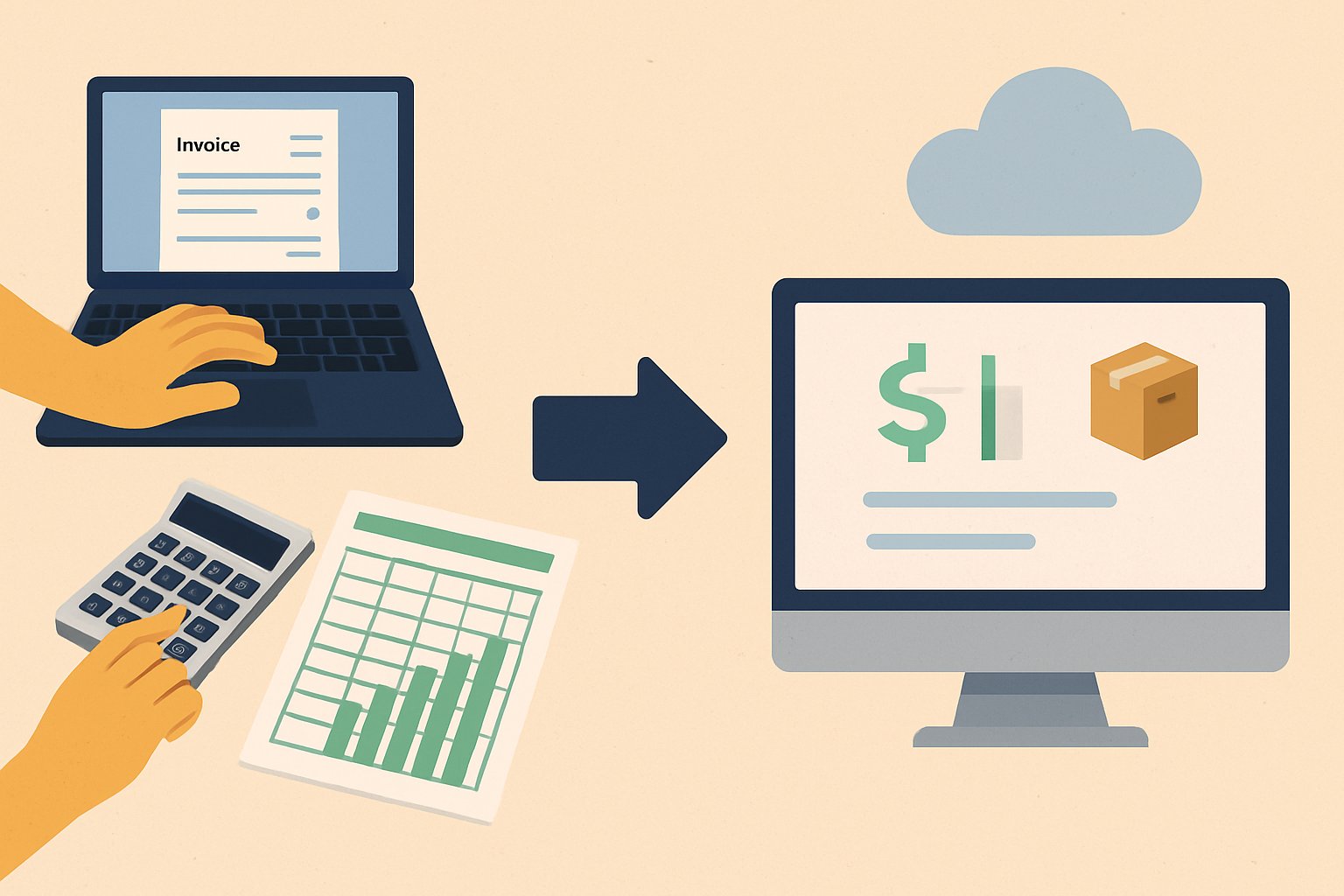
Invoices in One Place, Stock in Another: Unify Them
Invoicing in one system and tracking stock in Excel means doing the work twice. This is how a business changes when everything lives in one place.

Inventory That Doesn't Add Up: 5 Habits to Fix It
If your inventory never matches what is on the shelf, the problem is almost always the process. 5 habits to finally make it add up.