
In this article
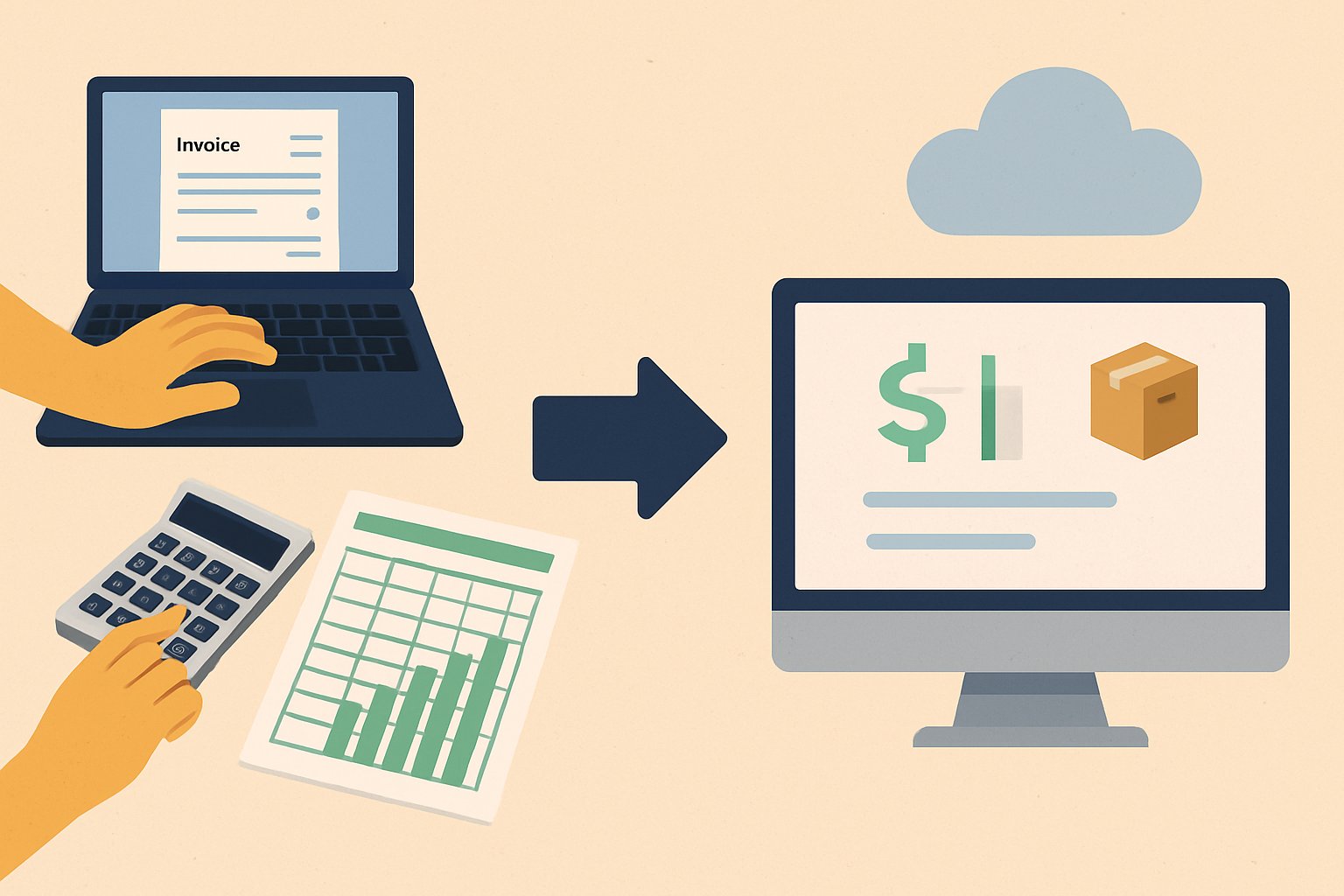
It is nine at night at a small cleaning products distributor in Santo Domingo. Mariela, the owner, has three windows open on her computer: the invoicing program, an Excel sheet with the inventory and another Excel sheet with accounts receivable. She is copying the day's sales, one by one, from one to the other.
Today she invoiced 38 times. Tomorrow she will have to do it all over again. And at the end of the month, when the accountant asks her for the information, she knows something will not match.
Mariela is an illustrative character. But if your business invoices in one system and tracks stock in another, you know this feeling well: working twice to get information that still does not give you peace of mind.
The problem with scattered information
When invoicing and inventory live in different places, three things almost always happen:
- Double work: every sale is recorded twice, and every manual entry is an opportunity for error.
- Stock that lies: the Excel sheet says there is product, but it has already been sold. Or the other way around: something that was in the warehouse does not get sold.
- Numbers without answers: you know how much you invoiced, but not how much you really earned, because the cost of goods sold is somewhere else.
Add to that last-minute accounting closes, duplicate versions of the Excel file ("inventory_final_v3_thisoneforreal.xlsx") and dependence on a single person who "knows how everything works".
The turning point: a single source of truth
One Monday, after yet another exhausting month-end close, Mariela asked herself a simple question: "Why do I have to write the same thing three times?". She started looking for a system where selling, invoicing and controlling inventory were a single action.
She had three conditions: it had to work with SRI electronic invoicing, she should not have to install servers in the office and her salesperson had to be able to use it without weeks of training. That is how she came to the free trial of JIVSoft's business management software.
How her day-to-day changed
1. Sell, invoice and deduct stock in a single step
Now, when Mariela records a sale, she issues the SRI-authorized electronic invoice and the inventory is updated automatically. Nothing to copy afterwards. The kardex keeps every movement of every product, so she always knows where a discrepancy came from.
2. All SRI documents in the same place
In addition to invoices, she can issue credit notes and withholding receipts, with customers identified by RUC or national ID (cédula) and support for the RIMPE regimes. Everything is backed up and easy to find.
3. An organized catalog
Her products come in several presentations. With the product catalog with variants, each presentation is part of the same product and not a loose row in an Excel sheet.
4. Customers with a history
Each customer has their own record and follow-up. Mariela can see what each store buys and how often, and she can send WhatsApp notifications.
5. Knowing how much she earns, not just how much she sells
With integrated double-entry accounting, the system generates the balance sheet and income statement. Her accountant no longer receives three different files, but organized information. And with the reports, Mariela can see which products leave the highest margin.
6. Her team, working on the same thing
The plan she chose allows up to 5 users: she, her salesperson, her assistant and the accountant all work on the same information, from the browser, without installing anything.
The first week, step by step
Switching systems is scary, especially when the business cannot stop. This is how Mariela did it:
- Day 1: she loaded her products with their presentations and the actual stock, counted that same day.
- Day 2: she registered her regular customers and set up electronic invoicing with her signature.
- Days 3 to 5: she sold and invoiced only from the system. At the end of each day she compared the inventory with the warehouse.
- Weekend: she reviewed the reports and showed the accountant how he would receive the information from that month on.
The Excel file was not deleted: it was kept as a historical backup. But it stopped being the everyday working tool.
Three ideas you can apply today
- Count how many times you record a sale. If it is more than once, there is your first opportunity to save hours.
- Define a single source of truth. Even if it is just one file at first, agree with your team on which one is "the official one" and get rid of copies.
- Look at margin, not just sales. Selling a lot of a low-margin product can be worse than selling a little of a profitable one.
The outcome and the lesson
Today Mariela closes her day in minutes. The inventory matches the warehouse, the accountant receives the information on time and she finally knows which products make her money and which ones only make her work.
The lesson: when information lives in one place, you stop managing files and start managing your business.
Try JIVSoft's management software
Everything Mariela uses is in the Business plan (from $39 + VAT per month, the most popular choice): sales, inventory and kardex, customers, SRI electronic invoicing, accounting, document management and advanced reports, for 5 users. If you are just starting out and do not yet need electronic invoicing or accounting, the Starter plan (from $19 + VAT) covers sales, inventory, customers and basic reports.
Try it free for 14 days, no credit card and no installation required. Write to us at 097 876 6762 or visit jivsoft.com. We will help you go from three windows to just one.
Related Articles
Keep exploring similar content.

Cancelling SRI Invoices: Your Deadline Is October 7
September invoices can only be cancelled until October 7. What the SRI rule says and 5 habits to avoid missing the deadline.
Inventory That Doesn't Add Up: 5 Habits to Fix It
If your inventory never matches what is on the shelf, the problem is almost always the process. 5 habits to finally make it add up.

Cloud Migration: A Vital Step in Technological Evolution
Did you know that 45% of companies have adopted a hybrid cloud strategy?