
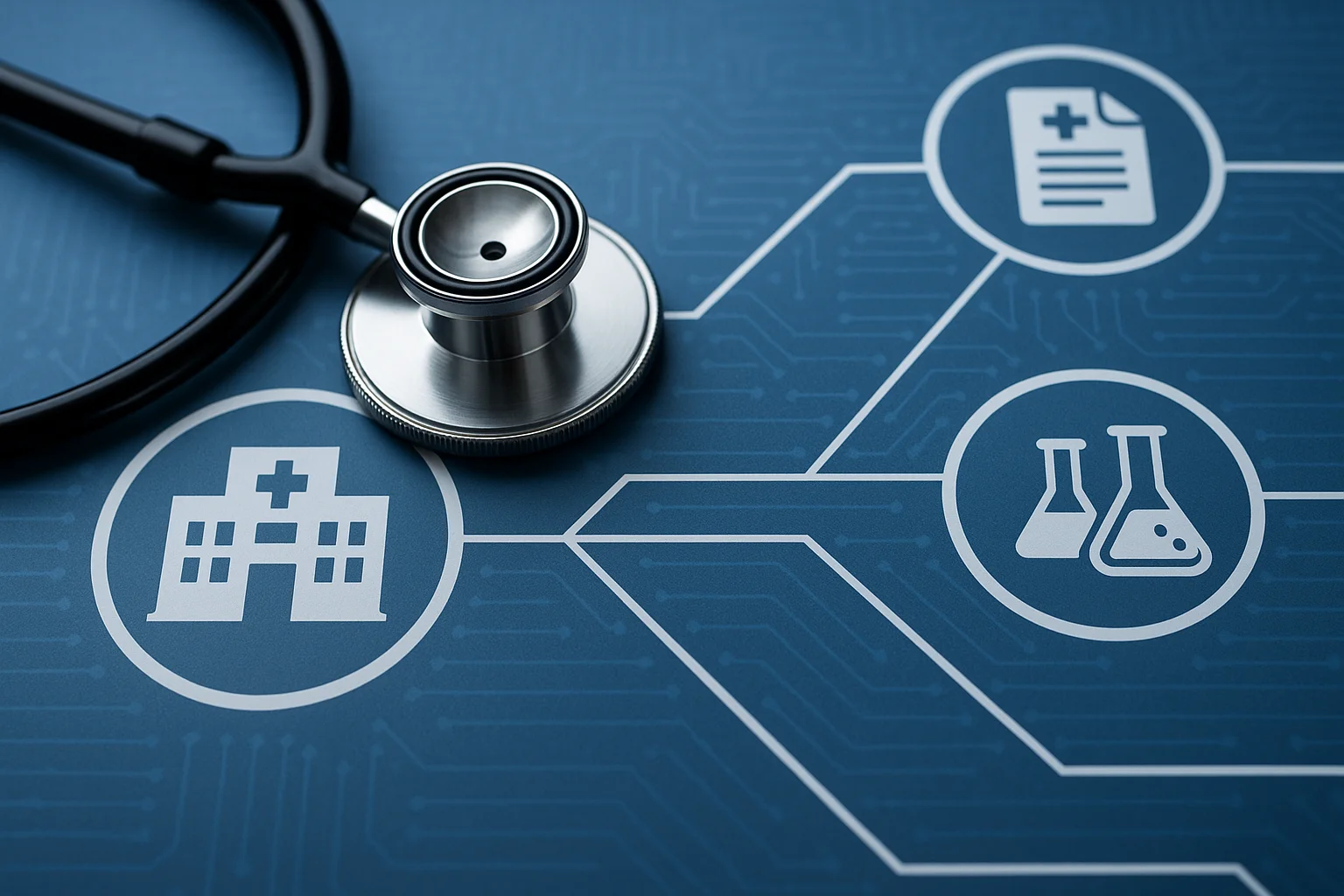
Healthcare Interoperability: Getting All Systems to Talk
Interoperability in healthcare: how to get all systems talking to each other
In the previous article, “Predictive prevention: detecting diseases before they appear”, we saw how medicine has gone from reacting to disease to anticipating it. But for that revolution to really work, something is essential: all systems must speak the same language. This is where a concept as technical as it is transformative comes into play: interoperability in healthcare.
The silent chaos of disconnected data
Imagine that every hospital, laboratory or clinic were a different country, with its own language, currency and laws. For years, that was the reality of the healthcare sector: systems that could not understand each other, incompatible databases and patients who had to repeat tests because their information could not travel. The lack of interoperability was not just a technical problem; it was a barrier to human care.
The result: data trapped in digital silos, duplicated efforts, incomplete diagnoses and an enormous loss of time and resources. It was necessary to create a common language that would allow information to be shared securely, in a standardized and efficient way.
What interoperability really means
Interoperability is not just about connecting computers: it is about connecting people, processes and decisions. In simple terms, it is the ability of different health systems —from hospitals and laboratories to wearables and mobile apps— to exchange and understand the same data without losing its context.
This involves three levels:
- Technical interoperability: systems can communicate with each other using common standards (such as HL7, FHIR or DICOM).
- Semantic interoperability: data has the same meaning regardless of the system that processes it (for example, a diagnosis coded the same way in every country).
- Organizational interoperability: institutions agree on protocols and policies to share information securely and ethically.
The challenge of integrating the digital ecosystem
With the arrival of wearables, telemedicine and artificial intelligence, the volume of medical data multiplied exponentially. But having millions of data points is useless if each system stores them in its own digital language. Today's challenge is to integrate all that information coherently and make it accessible to every player in the healthcare system.
Interoperability is, in essence, the invisible foundation on which digital medicine can truly work. Without it, predictive prevention, intelligent diagnostics and digital medical records would be islands without bridges.
The benefits of healthcare that communicates
- Better patient care: doctors access the complete history no matter where the patient was treated.
- Faster, more accurate decisions: data flows without friction, reducing errors and repeated tests.
- Resource optimization: health systems save time and money by eliminating redundant tasks.
- Global collaboration: researchers and professionals can share anonymous information to accelerate medical discoveries.
The challenge: security and trust
Sharing medical information also entails great responsibility. Interoperability can only be built on a solid foundation of cybersecurity, consent and ethics. Every piece of medical data is part of a person's story, and protecting it is as important as using it.
That is why international standards —such as FHIR (Fast Healthcare Interoperability Resources)— define not only how data is sent, but also how it is protected.
Conclusion
Interoperability in healthcare is the universal language that will make truly connected medicine possible. It allows data to flow, machines to learn and doctors to see each patient's complete history, regardless of the system or country. It is the definitive step toward an intelligent, collaborative, life-centered healthcare ecosystem.
← Previous: Predictive prevention: detecting diseases before they appear
Next: Medical blockchain: the era of absolute security and traceability →
Related Articles
Keep exploring similar content.
The Future Is Hybrid: Human Medicine + Artificial Intelligence
The future of medicine is neither human nor artificial: it is hybrid. An alliance between the doctor's empathy and the precision of algorithms that promises to save more lives and provide better care.
Smart Hospitals: What Healthcare Will Look Like in 2030
By 2030, hospitals will not just be buildings: they will be digital ecosystems where artificial intelligence, robotics and data come together to deliver personalized, safe and more human care.

Ethics, Privacy and Consent in Digital Medicine
Ethics, privacy and consent are the three pillars of modern digital medicine: they ensure that technology protects patient data and respects human will in every digital decision.